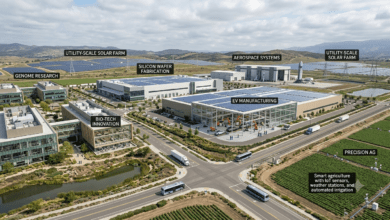
Across Corporate America, artificial intelligence has moved from experimental innovation labs into core operational strategies. From Fortune 500 boardrooms to mid-market enterprises, executive teams are deploying generative models, automated agents, and predictive algorithms to reimagine how work gets done.
This shift goes beyond automating repetitive tasks. AI in Corporate America is fundamentally restructuring job descriptions, talent acquisition, skill expectations, and long-term business planning. While the technology offers unprecedented gains in speed and operational efficiency, it also presents complex challenges—from managing workforce displacement and cybersecurity risks to addressing the human dynamics of AI adoption.
AI Is Changing the Nature of Work
The prevailing narrative surrounding AI often centers on absolute job elimination. However, corporate reality reveals a more nuanced transformation: AI is primarily reshaping how jobs are performed rather than simply erasing them.
In most white-collar disciplines, AI serves as a “digital copilot” or automated assistant. Instead of replacing full-time employees, AI tools absorb high-volume, low-complexity tasks—such as draft generation, basic data sorting, and initial customer triage—allowing workers to shift their focus toward high-value activities that require judgment, contextual knowledge, and strategic thinking.
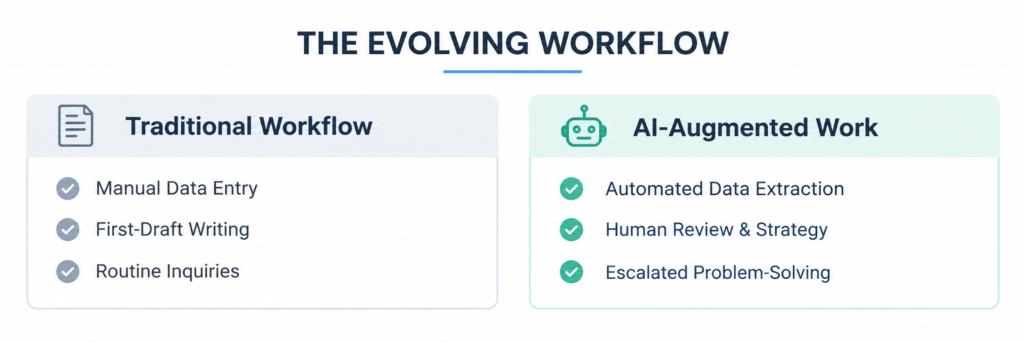
This evolution alters the ratio of routine maintenance to high-level strategy across multiple organizational functions:
-
Financial Analysis: Rather than spending hours consolidating spreadsheets, financial analysts use AI tools to run multi-variable risk simulations, shifting their time to strategic advisory roles.
-
Legal Operations: Legal teams leverage natural language processing to review thousands of contract clauses in minutes, allowing counsel to spend more time negotiating complex deals and assessing regulatory risk.
-
Software Development: Developers use code-generation tools to handle boilerplate syntax, refactoring, and initial bug testing, redirecting their creative efforts toward system architecture and user experience design.
The Impact on Hiring and Recruitment
Human Resources and talent acquisition departments are among the earliest adopters of enterprise AI, using automated systems to streamline sourcing, candidate screening, and internal workforce planning.
Algorithmic Candidate Screening
AI platforms parse thousands of resumes, match applicant profiles against core competency frameworks, and score candidates based on historical performance data. This capability significantly reduces time-to-hire for high-volume positions.
Predictive Skill Mapping
Enterprise HR teams utilize machine learning to analyze internal workforce capabilities, identify emerging skill gaps before they disrupt operations, and proactively map candidate profiles to future organizational needs.
Ethical and Algorithmic Concerns
While AI hiring tools improve operational efficiency, they also introduce risks. Screening algorithms trained on historical hiring data can inadvertently perpetuate historical biases. Consequently, U.S. regulatory bodies and enterprise legal teams are implementing strict audit frameworks to ensure algorithmic hiring complies with equal opportunity laws and non-discrimination mandates.
Why Reskilling Is Becoming Essential
As AI automates routine cognitive tasks, technical skills are experiencing a faster rate of obsolescence. According to research by Gartner, the half-life of technical skills in certain disciplines has contracted significantly, compelling organizations to prioritize continuous workforce reskilling over traditional static training programs.
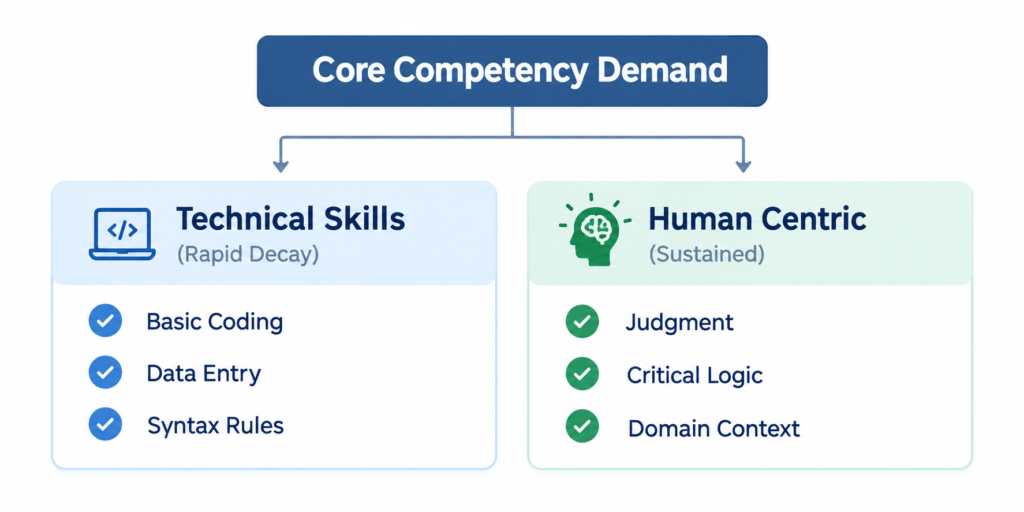
To maintain an agile workforce, enterprise leaders are investing in multi-tier upskilling initiatives:
-
Foundational AI Literacy: Training non-technical staff across marketing, sales, and operations on prompt engineering, outputs verification, and basic data governance.
-
Domain-Specific AI Application: Teaching specialized teams how to integrate domain-specific AI models into established workflows.
-
Augmented Leadership: Equipping mid-level managers to lead hybrid teams composed of human professionals and autonomous AI agents.
Companies that treat reskilling as an ongoing operational investment retain key organizational context and avoid the substantial costs associated with continuous workforce turnover.
AI and Employee Productivity
Integrating AI into corporate workflows offers clear productivity benefits alongside potential operational risks.
Productivity Gains Across Core Functions
-
Customer Operations: AI-driven agents resolve standard inquiries instantly, routing complex cases to specialized human representatives.
-
Research and Market Analysis: Generative research tools aggregate industry reports, competitive intel, and internal metrics into executive summaries, cutting preliminary analysis time significantly.
-
Content Generation & Design: Marketing teams use generative tools to rapidly produce campaign drafts, copy variants, and visual collateral.
Productivity Risks and Miscalculations
Despite these benefits, measuring the true impact of AI productivity remains challenging. Organizations often face specific operational pitfalls:
-
The Productivity Illusion: A 2026 Gartner survey revealed that measuring AI success purely by “hours saved” often misses true strategic value. Time saved on drafting can easily be consumed by the need to verify, fact-check, and edit AI-generated output.
-
Overreliance and Skill Atrophy: Overreliance on automated suggestions can erode foundational domain expertise, leaving teams less equipped to navigate edge cases or technical anomalies when systems fail.
-
Disillusionment and Rehiring Whiplash: Companies that prematurely reduce staff under the assumption that AI can fully replace human workers often experience operational bottlenecks. Gartner projects that across industries, 30% of employees laid off in AI-driven cost-cutting measures will need to be rehired by 2029 to restore lost domain expertise and human oversight.
How AI Is Changing Business Strategy
In boardrooms across the nation, AI has evolved from a Chief Information Officer (CIO) initiative into a core enterprise priority driven by Chief Executive Officers and Boards of Directors.
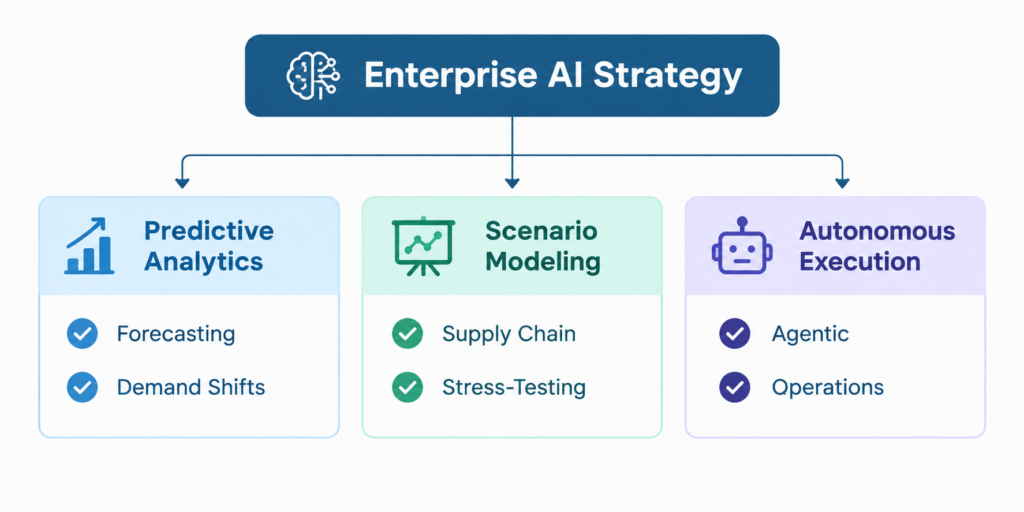
Strategic Applications in Decision-Making
-
Predictive Market Analytics: Enterprise platforms analyze real-time market data, consumer sentiment, and macroeconomic indicators to inform pricing, inventory management, and capital allocation.
-
Operational Scenario Modeling: Companies use custom AI models to simulate supply chain disruptions, tariff impacts, or shifts in customer demand, enabling dynamic risk management.
-
Product and Service Personalization: B2B and B2C enterprises build tailored user experiences around proprietary customer datasets, creating defensible market positions.
Reinvesting productivity gains into continuous innovation, legacy modernization, and workforce capability yields stronger long-term enterprise value than using AI strictly as a cost-cutting tool.
The Challenges of AI Adoption
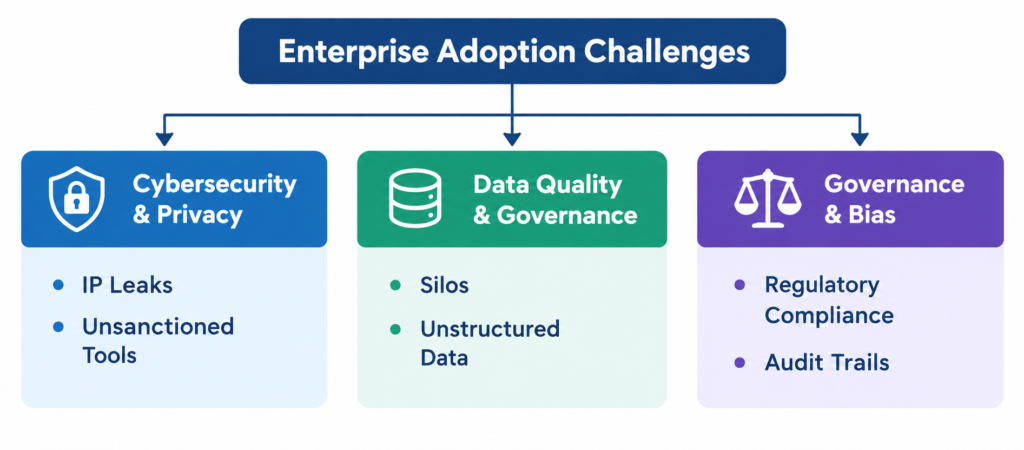
Integrating advanced AI across large enterprise structures introduces significant technical, operational, and regulatory challenges.
-
Cybersecurity and Data Privacy: Employees using unsanctioned consumer AI tools present significant risks of confidential corporate data and intellectual property exposure. Organizations must implement secure enterprise environments with strict data loss prevention (DLP) protocols.
-
Data Infrastructure and Quality: AI outputs depend on the quality of underlying data. Legacy data silos, inconsistent categorization, and uncurated datasets often impair enterprise deployment, requiring upfront investments in data modernizing.
-
Financial and Infrastructure Costs: Running specialized or domain-specific generative models entails high infrastructure costs, enterprise licensing fees, and integration overhead. Clear cost-benefit evaluation is necessary before scaling deployments.
-
Culture and Internal Resistance: Workforce anxiety over job security can slow adoption rates. Gartner surveys show that organizations fostering a culture of psychological safety, transparent communication, and role clarity experience significantly higher productivity from AI investments.
The Future of Corporate America’s Workforce
The enterprise landscape will increasingly be defined by structured human-machine collaboration rather than widespread automation.
As routine cognitive execution becomes standardized through software agents, uniquely human capabilities become primary differentiators for individual career growth and business performance:
| Skill Category | Why Value Is Increasing |
| Contextual Judgment | The ability to evaluate AI outputs for strategic nuance, ethical considerations, and real-world alignment. |
| Complex Problem-Solving | Navigating unstructured challenges where historical data is limited or non-existent. |
| Cross-Disciplinary Integration | Connecting technical capabilities with human operational goals across business units. |
| Ethical Oversight & Governance | Managing liability, regulatory compliance, and responsible deployment of automated systems. |
Organizations that balance automation efficiency with investments in human judgment will build sustainable competitive advantages.
Artificial intelligence is driving a fundamental structural shift across Corporate America. While the technology streamlines routine operations and generates new strategic insights, its success depends on the humans who guide, audit, and apply its outputs.
For business leaders, sustainable competitive advantage requires looking beyond short-term headcount reduction. Long-term performance stems from building robust data governance, providing clear workforce upskilling, and deploying AI to enhance human capabilities.
For working professionals, remaining competitive requires adopting a mindset of continuous adaptability. Developing foundational AI literacy alongside human-centered skills—such as critical judgment, domain expertise, and strategic problem-solving—ensures long-term relevance in an AI-assisted economy.