How AI and Advanced Analytics Are Changing the Way American Sports Teams Compete


In modern American sports, the margin between a championship victory and a devastating loss is often measured in millimeters and milliseconds. Winning once depended almost exclusively on a scout’s gut instinct or a head coach’s veteran intuition. Today, executives across the NFL, NBA, MLB, NHL, and MLS rely on sophisticated computational frameworks to sharpen every decision.
The integration of AI in American sports has catalyzed a data-driven paradigm shift. By processing millions of optical data points, high-frequency wearable sensor feeds, and complex biomechanical metrics in real time, machine learning algorithms and advanced analytics are redefining how sports organizations evaluate talent, design game strategies, and protect athlete health.
Data-Driven Player Evaluation and Roster Construction
Building a competitive roster is no longer just about eyeing basic traditional statistics. Front offices use machine learning models to identify hidden talents, project career trajectories, and manage salary caps with mathematical precision.
Advanced Talent Evaluation and College Scouting
In collegiate and entry-level scouting, predictive analytics eliminate traditional geographic limits and personal bias. Machine learning models analyze high-school and college performance data alongside tracking metrics, comparing prospective athletes against decades of historical player profiles:
-
NFL Scouting: The league’s annual Big Data Bowl challenges data scientists to create predictive metrics using player tracking data—evaluating subtle defensive reactions and route efficiency long before the NFL Combine.
-
MLB Draft & International Talent: Baseball front offices rely on high-speed Hawk-Eye tracking and Statcast data to measure exit velocities, spin rates, and swing mechanics across college and amateur international leagues.
-
NBA Draft Analytics: Front offices utilize optical tracking feeds to evaluate college prospects’ defensive coverage ranges, shot generation efficiency, and spatial awareness on the floor.
AI-Powered Performance Tracking and Biomechanics
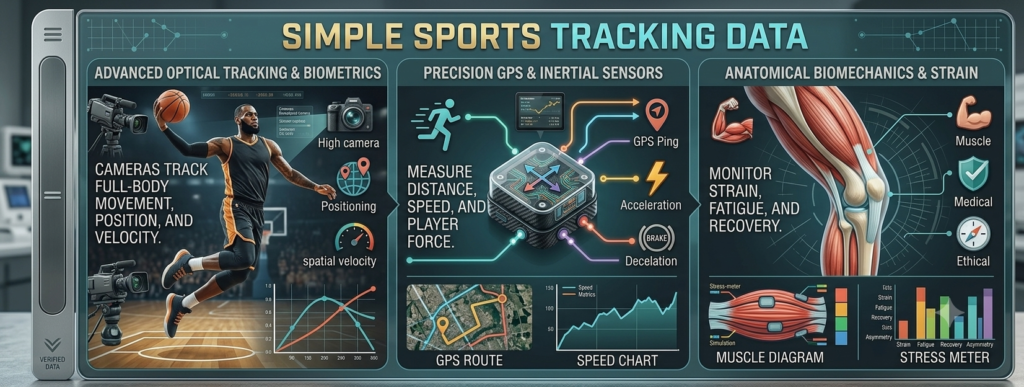
In-game and practice tracking technologies have fundamentally transformed how modern coaching staffs measure athlete performance.
High-resolution optical camera systems—such as Second Spectrum in the NBA and MLB’s Statcast system—capture full-body positional coordinates up to 60 times per second. Concurrently, wearable micro-technology featuring GPS trackers, tri-axial accelerometers, and heart-rate monitors capture internal physiological stress in real time during training sessions.
Tactical Optimization and Real-Time In-Game Decisions
Beyond talent recruitment, advanced analytics directly govern tactical play-calling on game day.
In-Game Tactical Decisions
Strategic decisions that once sparked fierce debate are now routinely resolved using probability models:
-
NFL Fourth-Down Strategy: Real-time win probability algorithms analyze field position, time remaining, defensive personnel, and weather conditions to inform head coaches on whether to punt, kick a field goal, or go for it on fourth down.
-
NBA Shot Selection: Shot-quality algorithms calculate expected points per possession based on defender proximity, shooter orientation, and time on the shot clock, solidifying the league-wide emphasis on three-pointers and rim attacks over mid-range jumpers.
-
MLB Defensive Shifts and Bullpen Usage: Defensive positioning and reliever matchups are calculated using historical spray charts and pitcher-batter matchup probabilities.
Opponent Analysis and Weakness Identification
Coaching staffs use computer vision models to automatically tag and index thousands of hours of opponent game footage. Instead of assistants manually logging play types, computer vision algorithms identify formation patterns, play-calling tendencies, and subtle defensive vulnerabilities in a fraction of the time.
Injury Prevention, Workload Monitoring, and Athlete Recovery
Player health represents a multi-million-dollar investment for professional sports franchises. AI models are shifting sports medicine from reactive treatment to proactive risk mitigation.
By monitoring changes in a player’s acceleration rates, running symmetry, or muscular fatigue levels, predictive systems alert athletic trainers when an athlete exhibits movement anomalies correlated with soft-tissue injuries. Teams use load-management strategies—resting players or adjusting practice intensity—to lower injury risks over long regular seasons.
Fan Engagement, Ticketing, and Modern Sports Broadcasting
The impact of AI in American sports extends beyond the court and field directly into the fan experience:
-
Dynamic Ticket Pricing: Predictive models adjust ticket prices in real time based on team performance, weather forecasts, ticket demand, and secondary market trends.
-
Personalized Content Delivery: Team apps and streaming services curate custom highlights, fantasy statistical updates, and targeted merchandise recommendations based on fan viewing history.
-
AI-Enhanced Broadcasts: Broadcasters incorporate real-time statistical overlays—such as AWS-powered Next Gen Stats in NFL broadcasts or real-time shot-probability graphics in NBA games—to give viewers deeper tactical context.
Ethical Questions: Privacy, Data Ownership, and Limitations
The rapid growth of sports technology raises complex ethical and operational considerations:
-
Data Ownership & Privacy: Collective bargaining agreements between leagues and player unions increasingly address who owns an athlete’s biometric and tracking data, and whether that data can influence contract negotiations.
-
Cybersecurity Risks: Storing proprietary strategic playbooks, medical records, and tracking metrics makes sports organizations target vectors for cyber threats.
-
Algorithmic Bias and Over-Reliance: Over-indexing on historical metrics risks overlooking human resilience, clutch execution, leadership traits, and team chemistry.
The Future Balance of Technology and Human Judgment
Looking ahead, sports technology will continue to advance rapidly. Generative AI tools will soon allow coaches to run conversational queries on complex video databases during half-time adjustments, while automated ball-strike systems (ABS) and augmented reality tools refine officiating precision.
Yet, technology remains a supportive tool rather than a replacement for human capability. Algorithms can process data and calculate probabilities, but they cannot feel the momentum of a live game, deliver an inspiring pre-game speech, or execute under high-pressure conditions. The most successful organizations in American sports will continue to be those that seamlessly fuse data-driven analytics with seasoned coaching experience and human intuition.