
We are entering a transformative era of technological convergence. Over the past decade, individual breakthroughs in cloud infrastructure, artificial intelligence, and high-speed wireless networks laid a foundational foundation. Now, these distinct technologies are fusing into unified, autonomous systems.
Understanding the technology trends next five years will bring is essential for business leaders, workers, consumers, and policymakers alike. The coming half-decade will not merely introduce incremental updates to existing tools; it will reshape how software operates in the physical world, how energy grids manage supply, and how human workers collaborate with intelligent systems.
1. Artificial Intelligence and AI Agents: Moving from Assistance to Action
Generative AI brought natural language understanding to the mainstream. However, the next phase of AI evolution shifts from passive text generation to agentic AI and multiagent systems.
Instead of simply answering a question or drafting an email, autonomous AI agents can reason through multi-step workflows, execute complex tasks independently, and coordinate with other specialized software agents.
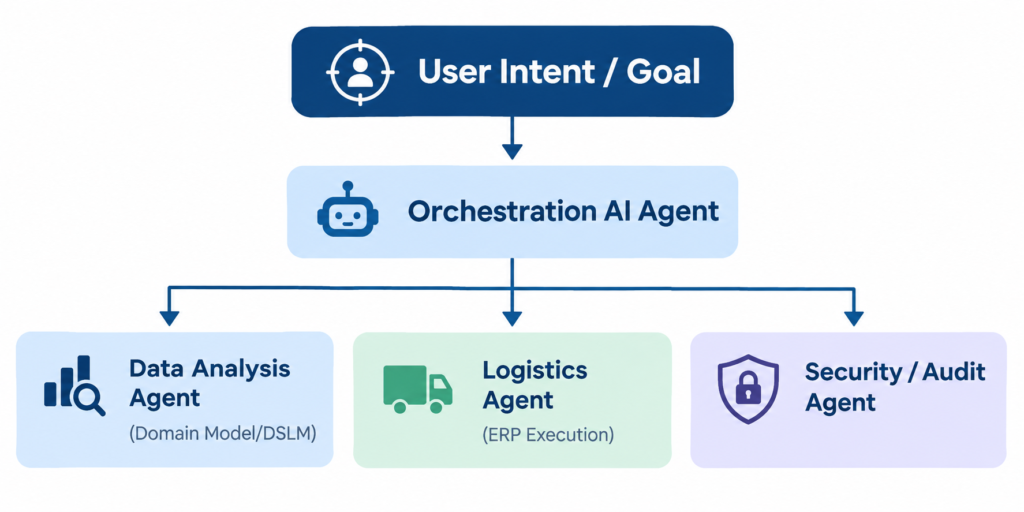
Domain-Specific Language Models (DSLMs): Rather than relying exclusively on massive, general-purpose models, enterprise strategies are pivoting toward smaller, highly accurate models trained on specific industry datasets.
-
Practical Applications: In financial services, multiagent networks automate complex compliance auditing. In customer operations, agents execute refunds, update logistics records, and coordinate vendor notifications without requiring human intervention at every step.
-
Challenges & Risks: As AI agents gain administrative access to core enterprise software, risks around runaway execution loops, data privacy breaches, and security vulnerabilities like prompt injection intensify.
2. Robotics and Physical AI: Intelligence Meets the Physical World
For decades, industrial robotics operated within strict, isolated environments, following rigid pre-programmed instructions. The integration of Physical AI—where multimodal foundation models act as the spatial brains for physical hardware—is bringing adaptability to hardware.
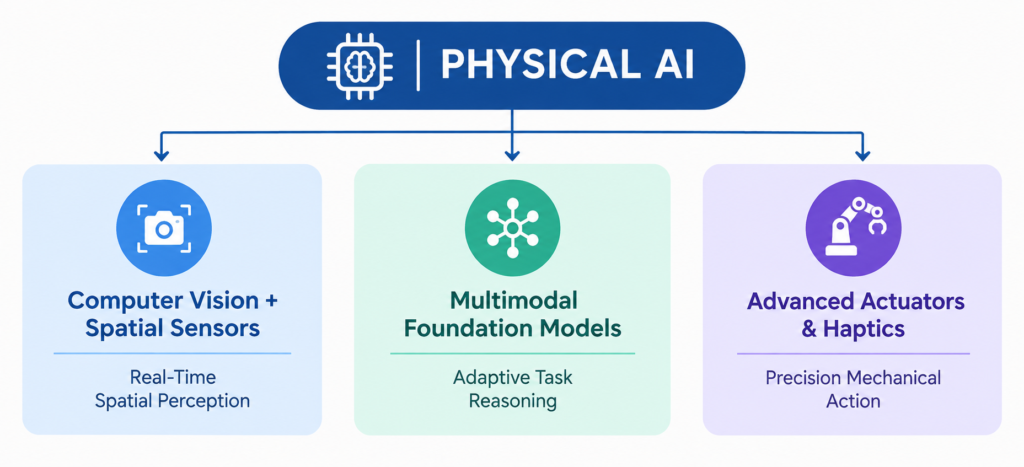
| Sector | Legacy Automation | Physical AI Integration (Next 5 Years) |
| Logistics & Warehouses | Fixed conveyor belts, magnetic-stripe guided carts | Dynamic autonomous mobile robots (AMRs) that adapt to unpredictable floor debris and shifting pallet locations |
| Manufacturing | Caged industrial arms restricted to repetitive welds | Collaborative cobots working alongside human technicians, learning tasks via visual demonstration |
| Healthcare | Tele-operated surgical tools | Semi-autonomous surgical assistance and automated hospital inventory distribution |
-
Key Drivers: Global labor shortages in skilled manufacturing, logistics, and eldercare are accelerating capital allocation toward physical automation.
-
Adoption Friction: High hardware costs, battery limitations, and strict safety certification standards mean widespread rollout will start in structured logistics hubs before expanding into unstructured consumer environments.
3. Advanced Computing: Quantum Foundations, Edge Nodes, and Custom Silicon
The computing infrastructure of the next five years is undergoing a structural split. On one side, massive hyper-scale data centers demand dedicated hardware; on the other, real-time edge hardware processes data locally.
-
Specialized AI Chips: Silicon architecture is moving away from general-purpose CPUs toward application-specific integrated circuits (ASICs) and specialized neural processing units (NPUs) engineered specifically for machine learning math.
-
Edge Computing Growth: High-volume IoT devices, smart vehicles, and industrial sensors require real-time execution. Processing data at the local edge drastically cuts latency and cuts bandwidth costs.
-
Quantum Computing Realities: Quantum systems will not replace everyday computers over the next five years. However, quantum advantage in specialized domain modeling—such as molecular simulations for material science and complex optimization problems—is moving out of purely academic labs into commercial testbeds.
4. Connectivity and Next-Generation Networks
Ultra-reliable low-latency communication forms the invisible backbone for distributed AI and real-time physical systems.
-
5G Advanced and 6G Research: As 5G Advanced deployments mature, research into 6G networks focuses on integrating sensing directly into communication spectrums, allowing networks to map physical spaces using radio signals.
-
Non-Terrestrial Networks (NTN): Low Earth Orbit (LEO) satellite constellations are bridging coverage gaps, delivering broadband access to remote maritime, aviation, and rural locations.
-
Industrial Impact: Ultra-reliable networks enable remote operational control for mining equipment, continuous agricultural soil diagnostics, and real-time tele-health procedures in rural regions.
5. Cybersecurity and Digital Privacy: The Escalating Defensive Arms Race
As infrastructure grows more interconnected, cybersecurity is shifting from periodic patch cycles to real-time, preemptive defensive security platforms.
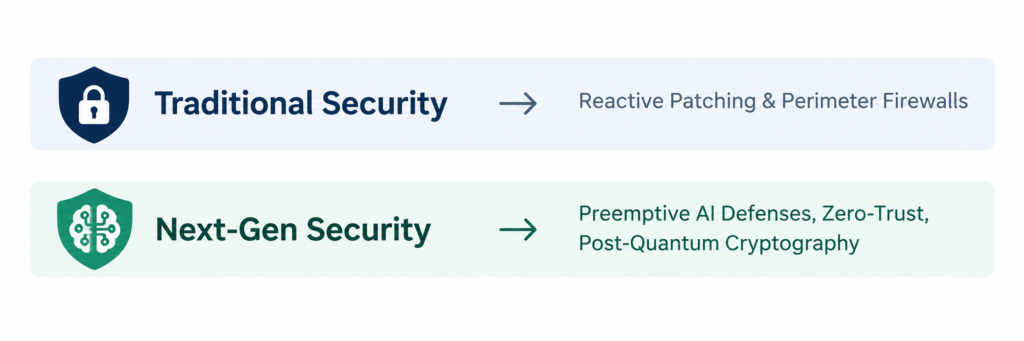
AI vs. AI Defense: Security teams leverage machine learning engines to detect zero-day exploits and abnormal network behaviors instantly. Simultaneously, malicious actors use automated tools to generate hyper-personalized phishing vectors and automated payload adaptations.
-
Post-Quantum Cryptography (PQC): With quantum hardware advancing, governments and enterprises are beginning early migrations to PQC algorithms to prevent “harvest now, decrypt later” attack strategies.
-
Digital Provenance and Identity: The proliferation of synthetic media makes digital content verification critical. Protocols like C2PA (Coalition for Content Provenance and Authenticity) use cryptographic watermarking to verify content origins.
6. Biotechnology and Digital Healthcare
Biotechnology is increasingly operating like a software engineering discipline, driven by predictive biological modeling and precise diagnostic tools.
-
AI-Assisted Drug Discovery: Algorithms that predict complex protein structures reduce early-stage drug target identification timelines from years to months.
-
Personalized Medicine & Wearables: Consumer health sensors are transitioning from basic step tracking to clinical-grade, continuous monitoring (e.g., continuous glucose metrics, ECG analytics, and early biomarker detection).
-
Data Integration Challenges: Unlocking the full potential of digital health requires navigating fragmented Electronic Health Record (EHR) frameworks, strict HIPAA/GDPR compliance, and ensuring biological data privacy.
7. Clean Energy and Climate Technology
The massive power demands of computational data centers, coupled with industrial decarbonization commitments, make climate technology a foundational pillar of future tech infrastructure.
-
Advanced Battery Storage: Transitioning beyond standard lithium-ion, developments in solid-state batteries, sodium-ion chemistries, and long-duration utility storage are essential for stabilization of renewable energy grids.
-
Smart Grids & Microgrids: Microgrid architectures powered by predictive AI optimize electricity distribution dynamically, balancing volatile solar and wind inputs against localized demand spikes.
-
Grid Infrastructure Demands: Power grid capacity is rapidly emerging as a primary bottleneck for data center expansion and EV adoption, driving renewed commercial interest in small modular reactors (SMRs) and advanced thermal storage.
8. Spatial Computing and Immersive Hardware
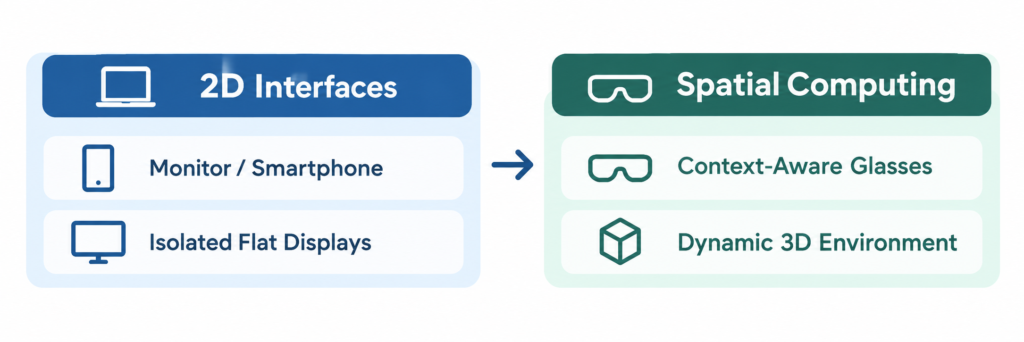
Spatial computing aims to shift human interaction away from flat 2D glass screens toward context-aware, 3D digital overlays.
-
Form Factor Evolution: While bulky Virtual Reality (VR) headsets retain a strong niche in gaming and specialized industrial training, the consumer focus is shifting toward lightweight Augmented Reality (AR) smart glasses equipped with multimodal AI companions.
-
Enterprise Training: Engineers, surgeons, and maintenance technicians deploy mixed-reality overlays to view complex schematics or step-by-step assembly guides hands-free in physical work zones.
-
Barriers to Scale: Thermal dissipation, display brightness under sunlight, battery life constraints, and social friction remain real challenges that hardware makers must solve before mainstream consumer replacement of smartphones can occur.
9. The Future of Work: Augmentation, Upskilling, and Workflow Redesign
The integration of advanced software tools is changing workplace task structures faster than previous industrial shifts.
-
Task Redesign over Job Displacement: Rather than eliminating whole job categories outright, technology is disaggregating jobs into individual tasks. Routine data synthesis, basic coding scaffolding, and administrative scheduling are increasingly automated, shifting human workloads toward strategy, complex judgment, and physical execution.
-
The Productivity Divide: Organizations that systematically restructure business processes around human-AI collaboration achieve far higher ROI than those that simply layer new AI tools on top of legacy workflows.
-
Continuous Reskilling: Technical skills face shorter relevance lifespans. As a result, internal corporate upskilling programs and flexible learning pathways are becoming core operational requirements rather than optional HR perks.
10. What Could Define the Next Five Years?
While numerous innovations compete for market attention, their near-term impact varies significantly based on technical readiness, capital investment, and regulatory hurdles.
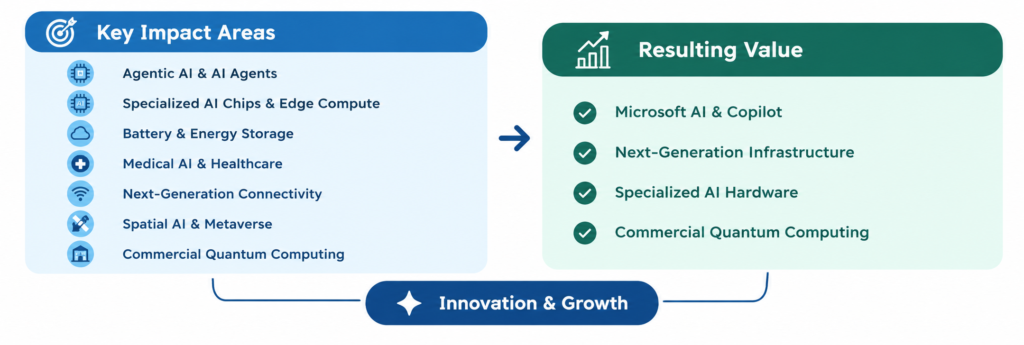
High-Impact Near-Term Drivers (Years 1–3)
-
Agentic AI & Multiagent Workflows: Immediate enterprise deployment yields direct, measurable software productivity gains.
-
Next-Gen Energy Storage & Grid Tech: Essential infrastructure investments required to keep pace with global electrification and computing energy demands.
-
Edge Computing & Custom Silicon: Near-term adoption driven by efficiency demands in smartphones, automotive platforms, and industrial machinery.
Long-Term Transformational Shifts (Years 3–5+)
-
Physical AI & Humanoid Robotics: Widespread industrial adoption will follow once hardware costs decrease and spatial foundation models mature.
-
Post-Quantum Encryption Standards: Regulatory mandates will drive enterprise migrations over several years.
-
Consumer AR Spatial Hardware: Widespread adoption hinges on significant miniaturization and battery energy density breakthroughs.
Frequently Asked Questions
What is the difference between Generative AI and Agentic AI?
Generative AI focuses on creating content—such as text, images, or code—based on human prompts. Agentic AI goes a step further by evaluating goals, planning multi-step actions, making decisions, and using external software tools autonomously to complete end-to-end tasks with minimal human intervention.
How will edge computing affect everyday consumer technology?
Edge computing processes data directly on local devices (like smartphones, smart appliances, or vehicles) rather than sending it to distant cloud data centers. This results in faster response times, reduced internet bandwidth usage, and better data privacy, as sensitive information can remain stored locally on the device.
Are humanoid robots expected to enter homes in the next five years?
While humanoid robots are advancing rapidly, their deployment over the next five years will primarily occur in controlled environments such as warehouses, manufacturing plants, and commercial logistics hubs. High production costs and safety challenges make broad home consumer adoption unlikely in the immediate term.
Why is cybersecurity shifting toward post-quantum cryptography now?
Quantum computers are expected to eventually become powerful enough to break traditional encryption algorithms (like RSA and ECC). Because migrating global digital infrastructure takes years, organizations are proactively implementing post-quantum cryptography today to secure sensitive data against “harvest now, decrypt later” threats.
What technology skill sets will be most valuable for workers over the next five years?
Key technical skills include data literacy, system design, cybersecurity awareness, and prompt engineering/AI orchestration. Adaptability, critical thinking, complex problem-solving, and cross-disciplinary collaboration will remain critical human advantages alongside automated systems.
The technological landscape of the next five years will be defined by integration and autonomy. As AI moves from software screens into physical machines, networks expand to connect remote edge nodes, and energy systems adapt to dynamic computing loads, the boundary between digital intelligence and physical operations will continue to shrink.
Organizations, policy makers, and individuals who focus on adaptability, infrastructure resilience, and responsible governance will be best positioned to navigate and thrive through these shifts.