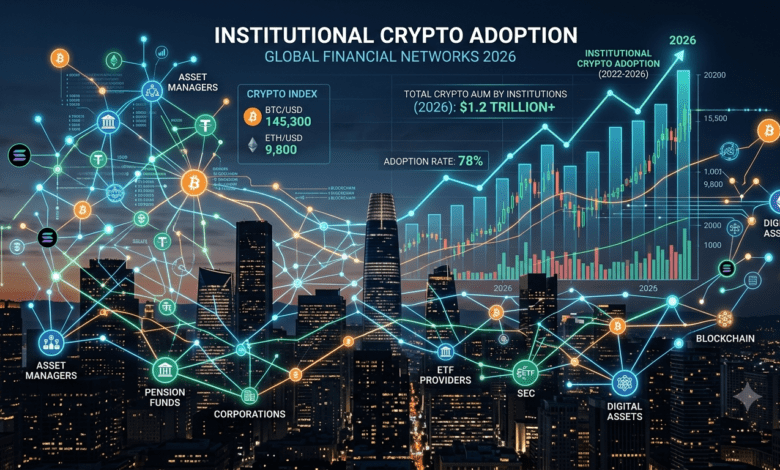
The cryptocurrency market has entered a fundamental structural transition. The days when digital assets were driven primarily by retail speculation, viral meme cycles, and unconstrained leverage are yielding to an era anchored by institutional custody, formal regulatory frameworks, and enterprise-grade utility.
As the crypto market 2026 landscape matures, market participants are looking beyond short-term price movements. Instead, investors are closely monitoring structural forces: the integration of traditional financial assets on-chain, unified regulatory deadlines across major jurisdictions, and the convergence of artificial intelligence with decentralized infrastructure.
Why 2026 Could Be a Turning Point for Crypto
The crypto ecosystem is moving past earlier retail-led boom-and-bust cycles. Historically, market expansions were triggered almost exclusively by retail liquidity and retail-driven derivatives leverage. In 2026, market stability is increasingly anchored by institutional balance sheets, long-term asset managers, and sovereign-level infrastructure planning.
Key macro shifts defining this turning point include:
-
Maturation of Infrastructure: Latency, scalability, and security bottlenecks that hindered earlier cycles have largely been addressed through layer-2 rollups, zero-knowledge proofs, and institutional-grade custody architectures.
-
Reduced Volatility Volatility: While digital assets remain inherently volatile, market depth across major liquid assets like Bitcoin and Ethereum has broadened, dampening extreme liquidation cascades.
-
Shift to Fundamental Value: Investor focus has shifted from high-emission speculative tokens toward protocols generating verifiable protocol revenue, fee-sharing metrics, and real-world cash flows.
Institutional Adoption and Crypto Investment Products
Institutional participation in digital assets is no longer experimental. Wall Street asset managers, corporate treasuries, and pension funds have integrated crypto allocations directly into standard portfolio strategies.
                     Institutional Crypto Access Channels (2026)
                                         │
        ┌────────────────────────────────┼────────────────────────────────┐
        ▼                                ▼                                ▼
Spot ETFs & ETPs             Digital Asset Treasuries          Staking-Enabled Products
(BTC, ETH, Altcoins)       (Corporate & Sovereign Reserves)  (Liquid Yield Derivatives)
Spot ETFs and Broadened Product Access
Following the historic rollout of spot Bitcoin and Ethereum ETFs in early 2024, the market in 2026 has seen an expansion into diversified crypto index funds and single-asset altcoin ETPs. Asset managers are increasingly launching liquid staking-enabled funds, allowing institutional holders to capture network yield alongside spot price exposure.
Corporate Treasuries and Capital Market Integration
Beyond exchange-traded funds, corporate balance-sheet adoption has shifted toward “Digital Asset Treasuries 2.0”. Rather than holding digital tokens strictly as passive treasury reserves, institutions are actively deploying assets into institutional permissioned pools, acquiring block space as a strategic technology commodity, and utilizing institutional repo markets built on blockchain rails. This shift significantly deepens market liquidity and limits drastic downside selling pressure.
Regulation Is Becoming a Bigger Market Driver
Regulatory developments are actively defining market architecture. Global regulators have transitioned from ad-hoc enforcement to structural oversight, creating a clearer boundary between compliant and non-compliant digital asset services.
| Jurisdiction | Key Regulatory Framework / Legislation | Primary Focus & 2026 Impact |
| European Union | Markets in Crypto-Assets (MiCA) | Full end of transitional grandfathering on July 1, 2026; mandatory authorization for all CASPs. |
| United States | Market Structure & Payment Stablecoin Guidance | Federal reserve standards for stablecoin issuers and SEC/CFTC boundary classifications. |
| United Kingdom | Financial Conduct Authority (FCA) Stablecoin Regime | Implementation of secondary legislation in 2026 enforcing 1:1 liquid backing and reserve audits. |
| Asia-Pacific (HK/SG/JP) | Monetary Authority / Financial Services Agency Rules | Licensing regimes for fiat-pegged tokens and institutional tokenization sandboxes. |
The end of the EU’s MiCA grandfathering period on July 1, 2026, represents a watershed moment. Unlicensed Crypto-Asset Service Providers (CASPs) can no longer operate within the bloc, consolidating liquidity around fully compliant institutions. While strict compliance increases operational overhead for smaller startups, it provides the legal certainty required for massive conservative capital pools to enter the space.
Bitcoin and the Broader Crypto Market
Bitcoin continues to hold its position as the market’s primary macro reserve asset and digital gold equivalent. However, the broader digital asset landscape is decoupling based on functionality:
-
Bitcoin as Macro Collateral: Bitcoin’s primary narrative is firmly anchored around macro-hedging, corporate treasury reserve status, and base-layer security settlement.
-
Smart Contract Dominance: Layer-1 and Layer-2 execution networks (such as Ethereum, Solana, and specialized application chains) are increasingly evaluated based on transaction volume, network throughput, total value locked (TVL), and developer retention rather than pure store-of-value narratives.
-
Asset Decoupling: Historically, when Bitcoin experienced volatility, all altcoins moved in direct correlation. In 2026, protocols with strong organic cash flows and active network usage are exhibiting price independence from broader Bitcoin movements.
Stablecoins and the Growth of On-Chain Finance
Stablecoins have evolved from simple trading venue liquidity pairs into global payment, clearing, and cross-border settlement infrastructure.
┌─────────────────────────────────────────────────────────────────────────────────┐
│                          STABLECOIN UTILITY IN 2026                             │
├───────────────────┬───────────────────┬───────────────────┬─────────────────────┤
│   Cross-Border    │ Corporate Treasury│ On-Chain Settlement│  Humanitarian Aid   │
│   B2B Payments    │   Digital Hedging │   & DeFi Collateral│   & Micro-Pay Rails │
│ (Low FX Friction) │ (Dollar Stability)│ (Atomic Liquidity)│ (Mobile Cash Delivery)│
└───────────────────┴───────────────────┴───────────────────┴─────────────────────┘
Driven by strict regulatory oversight requiring 100% high-quality liquid asset reserves (such as short-term U.S. Treasury bills and central bank deposits), dollar-denominated stablecoins operate alongside traditional payment networks. International business-to-business (B2B) payments, global payroll solutions, and institutional trade settlement rely heavily on stablecoin rails due to their near-instant settlement speed and dramatically lower transaction fees compared to legacy correspondent banking systems.
The Next Evolution of DeFi
Decentralized Finance (DeFi) has undergone a major transformation following early-stage experimental yield farming. The 2026 DeFi ecosystem focuses on security, sustainability, and capital efficiency:
-
Institutional-Grade DeFi (Permissioned Pools): Decentralized protocols are integrating identity verification (KYC) options at the smart contract level, allowing institutional funds to interact safely with automated market makers (AMMs) and lending protocols without breaching compliance rules.
-
Sustainable Economic Models (Tokenomics 2.0): Protocols have shifted away from inflationary token rewards. Modern protocol economics prioritize fee-sharing mechanisms, protocol buybacks, and yield derived directly from underlying service fees.
-
Formal Security Frameworks: Smart contract auditing has matured, with formal verification mathematics and automated automated exploit monitoring becoming standard practice before protocol deployment.
Tokenization and Real-World Assets (RWA)
The tokenization of Real-World Assets (RWAs) is one of the fastest-growing market segments in digital finance. Financial institutions are wrapping traditional financial instruments onto blockchain networks to enable 24/7 settlement, fractional ownership, and automated collateral management.
-
Tokenized Money Market Funds & Treasuries: Products such as tokenized U.S. Treasury bills have scaled significantly, allowing corporate treasuries to hold liquid, interest-bearing sovereign debt natively on-chain.
-
Private Credit & Debt: On-chain private credit protocols allow institutional borrowers to access global liquidity directly, while providing lenders with transparent auditability of underlying loan portfolios.
-
Equities & Real Estate: Traditional securities—including fund shares, commercial real estate equity, and private equity stakes—are being tokenized under financial frameworks like MiFID II in Europe and SEC guidelines in the United States, expanding investor access to historically illiquid markets.
Crypto and Artificial Intelligence
The convergence of artificial intelligence and blockchain technology has moved past initial speculation into functional, operational infrastructure.
                     AI x Crypto Integration Architecture
                                       │
       ┌───────────────────────────────┼───────────────────────────────┐
       ▼                               ▼                               ▼
Autonomous AI Agents          Decentralized Compute            Data Authenticity
(Using Stablecoins / x402     (GPU Networks for Model          (Cryptographic Provenance
 Rails for Micro-Payments)     Training & Inference)            & Anti-Deepfake Verification)
-
Autonomous Agentic Payments: Artificial intelligence agents operating independently require programmable, frictionless payment infrastructure. Machine-to-machine micropayments are increasingly executed using stablecoins and dedicated open payment protocols (such as x402), enabling AI agents to autonomously buy data, hire compute capacity, or pay for API calls in real time.
-
Decentralized Physical Infrastructure Networks (DePIN): Decentralized physical networks aggregate worldwide idle GPU computing power, offering AI developers cost-effective training and inference infrastructure without reliance on centralized cloud monopolies.
-
Data Provenance and Cryptographic Verification: As generative AI models proliferate, zero-knowledge proofs and blockchain ledger timestamps are deployed to verify the authenticity of digital media, dataset provenance, and AI-generated outputs.
What Investors Are Watching in 2026
Investors navigating the crypto market 2026 environment monitor a specific set of operational and macroeconomic metrics:
-
Institutional Net Inflows: Tracking sustained capital flows into spot ETPs, digital asset treasuries, and custody platforms.
-
Global Regulatory Milestones: Monitoring key implementation dates, including the end of MiCA’s EU transition phase on July 1, 2026, and evolving U.S. stablecoin legislation.
-
Stablecoin Supply & Velocity: Measuring total stablecoin market capitalization and on-chain transaction volume as an indicator of global economic liquidity.
-
Total Value Locked (TVL) in RWAs: Tracking the total dollar volume of tokenized traditional assets like Treasuries and private debt moving onto public and permissioned ledgers.
-
Protocol Revenue vs. Valuation: Evaluating smart contract platforms based on price-to-earnings (P/E) ratios and organic protocol fee capture.
-
Macroeconomic Interest Rate Cycles: Assessing central bank policy shifts, as global liquidity conditions directly influence appetite for risk assets across traditional and digital markets.
The Biggest Risks Investors Should Consider
Despite market maturity, digital asset investing carries structural and financial risks:
-
Regulatory Friction: Sudden policy shifts, restrictive compliance requirements, or jurisdictional fragmentation can restrict token liquidity and increase operational costs.
-
Smart Contract Vulnerabilities: While auditing standards have improved, smart contract bugs, flash loan exploits, and protocol hacks remain persistent threats in complex DeFi applications.
-
Liquidity & Market Structure Risks: Secondary markets for less liquid altcoins or niche tokenized assets may experience wide bid-ask spreads and severe price slippage during broad market downturns.
-
Systemic Macroeconomic Shocks: Broader macroeconomic stress, persistent inflation, or geopolitical instability can drive sudden deleveraging across all high-beta asset classes.
-
Speculative Bubbles & Overvaluation: Early-stage narratives—particularly around unproven AI-crypto integrations—can lead to extreme market overvaluation followed by sharp corrections.
What Could Define Crypto’s Next Phase?
The defining characteristic of crypto’s next phase is the shift from speculative narrative to built-in financial utility. Over previous market cycles, token valuations were driven almost exclusively by future expectations and market reflexive hype.
Moving forward, the networks and applications that capture long-term market share will be those that solve real-world financial friction: enabling cheaper cross-border payments, providing transparent capital access through tokenization, securing autonomous machine transactions, and offering institutional investors clear, predictable yield mechanisms within regulated parameters.
The crypto market 2026 landscape marks a transition point for digital assets. As regulatory frameworks like the EU’s MiCA settle into full enforcement and traditional financial institutions expand their on-chain operations, crypto is establishing itself as a core component of the global financial architecture.
Investors navigating this phase must maintain a disciplined approach. By focusing on underlying protocol revenues, institutional adoption metrics, regulatory compliance, and real-world asset growth, investors can separate lasting technological transformation from short-term market noise. Ultimately, crypto’s next era will be measured not just by market capitalization charts, but by how seamlessly blockchain infrastructure integrates into everyday financial systems.